


The public swimming pool, depending on how you orient your world view, could be a utopia. Or like Sartre’s take on “other people”: hell.
For Neddy Merrill, the antihero of John Cheever’s short story, portrayed by Burt Lancaster in its film adaptation The Swimmer (1968)1, it’s the final insult.
At the film’s first glamorous, private pool, he sees “with a cartographer’s eye, a string of swimming pools, a quasi-subterranean stream that curved across the county” and decides to “enlarge and celebrate” the beautiful day with a long swim back home across them, delighting in all their transformative - or restorative - powers.
“Being embraced and sustained by the light-green water seemed not as much a pleasure as the resumption of a natural condition.”2
The journey becomes less cross-country and more of a descent, with the final, public pool as his Ninth Circle of hell. Reduced to cadging 50 cents for entry, demeaned by a spot check of the dirty soles of his feet, he eventually muscles in to work his final, desperate length through the hoi polloi from which he’s designed an adult life at a stately distance.
Just four years earlier, Mikheil Kalatozishvili committed to film perhaps the most famous pool sequence in cinema history. His glorious one-take on the rooftop of the Hotel Capri in Havana for Soy Cuba (1964), not quite as ‘public’ a pool as the one in The Swimmer but nevertheless one open to the public in Castro’s revolutionary socialist state, could not be more tonally different.
A ranging demographic of guests drink, sunbathe, play cards and intermingle around the pool before submerging together, bodies interwoven in its cooling respite.
Somewhere beneath, or above, or plain oblivious to this ‘heaven’ and ‘hell’ is the British experience. One where lords of the realm rub shoulders with the unemployed to grab our flighty British summer when it’s suddenly got its hat on and squeeze every drop out together.
1995 was a heatwave3. One of the hottest summers of the twentieth century.
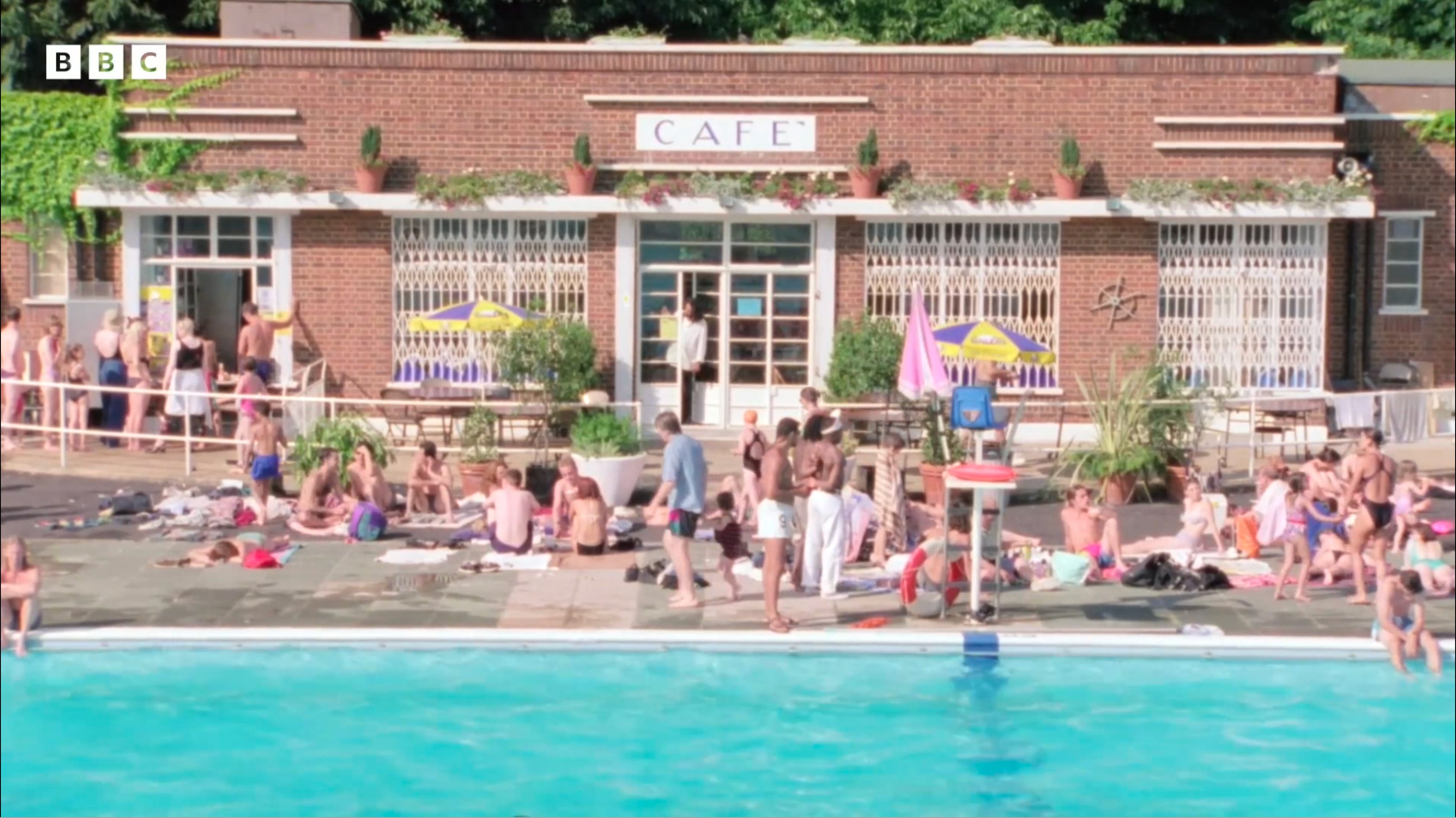
That summer, director Lucy Blakstad created her first entry into the BBC’s Modern Times series with Lido (1995), a wonderful documentary that combines tremendous craft and attention with large-hearted curiosity about the lives of the swimmers (and spectators) who gather at London’s Brockwell Park Lido, a spot sometimes referred to locally as ‘Brixton Beach’4.
It’s available to watch on the BBC Archive YouTube, a treasure trove for docs and nonfiction pulled from the broadcaster’s history.
Signs of the Times, Modern Times & a British golden age
Blakstad was first hired by the BBC as a graphic designer and later earned awards for her tight, innovative work on idents. But an invitation from director Nick Barker provided a pathway into a different world - documentaries - on Signs of the Times (1992).
The series explored good and bad taste in the British home and the emotional relationship with personal objects, photographed by one of the nation’s best chroniclers of the charming, eccentric (and foolish): Martin Parr.
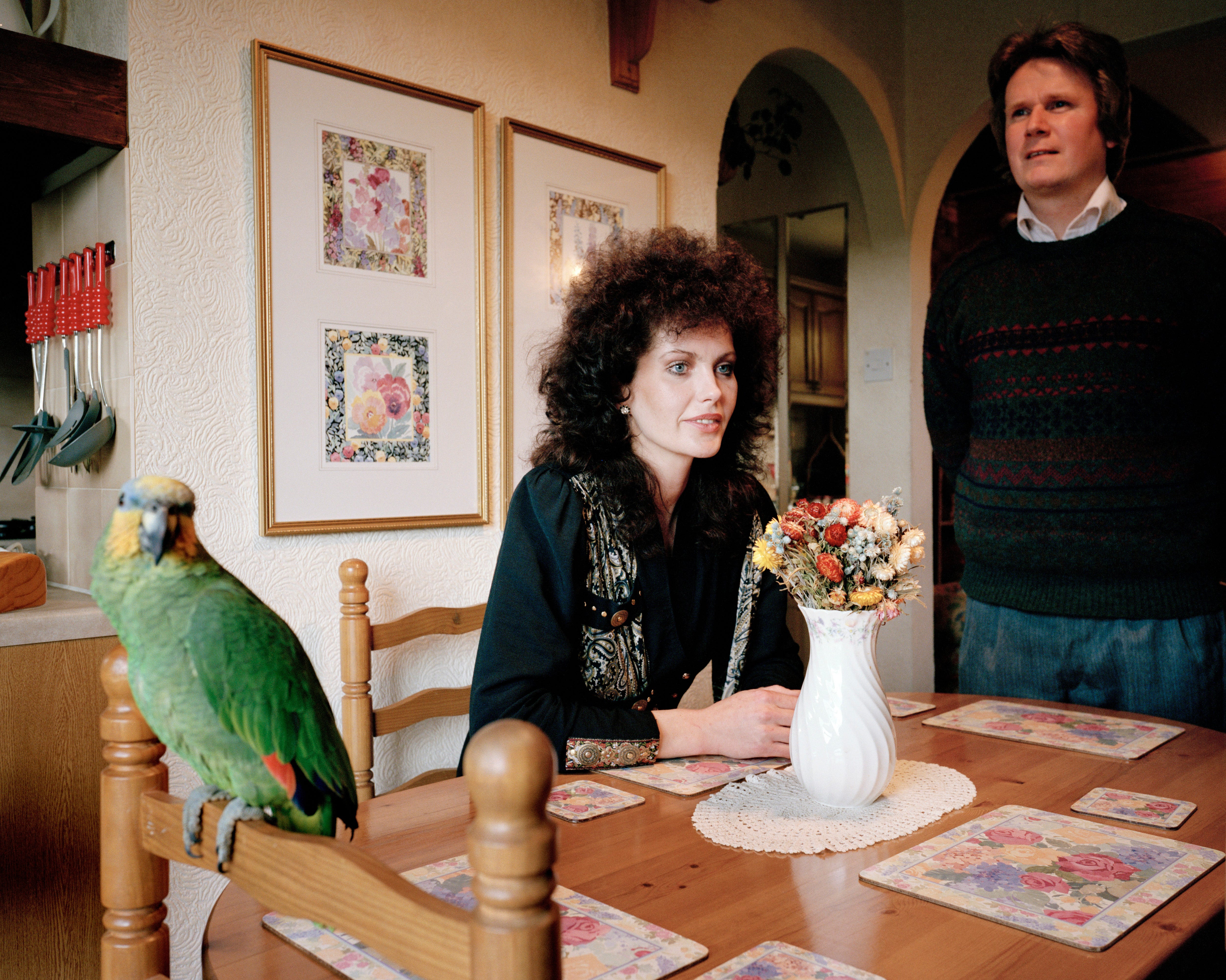
By researching and conducting the interviews in the series, Blakstad was able to start developing a process that “hasn’t changed. It’s perhaps been finessed”.
“Maybe it’s a naivety, maybe it’s just a curiosity. But it’s people-centred. I want to make films about people and what’s going on in their head and find the similarities.”5
It led to the next big break, her blend of soft interviewing skills and sharp designer’s eye abundantly clear, with another BBC series: Modern Times.
Founding editor Stephen Lambert, whose later work shifted to docu-soaps, reality TV and national tongue-waggers like Wife Swap, Gogglebox, The Traitors and Naked Attraction was keen to give one director “a chance to fly, a chance to experiment”6. (He later commissioned both Parr and Adam Curtis as directors in the series, and exec produced The Century of the Self (2002) and The Power of Nightmares (2004) for Curtis).
It took months to finally agree on the commission, but Blakstad’s vision was clear:
“I definitely want to do a film where people from all walks of life - I saw it like a platform - people all cross this one place. It could be a corner shop. It could be an airport. It could be a train station. I made a massive list of all the localities it could be. And swimming pool was on there. I thought that could be interesting visually. Then I thought, ooh, outdoor swimming pool - lido.”
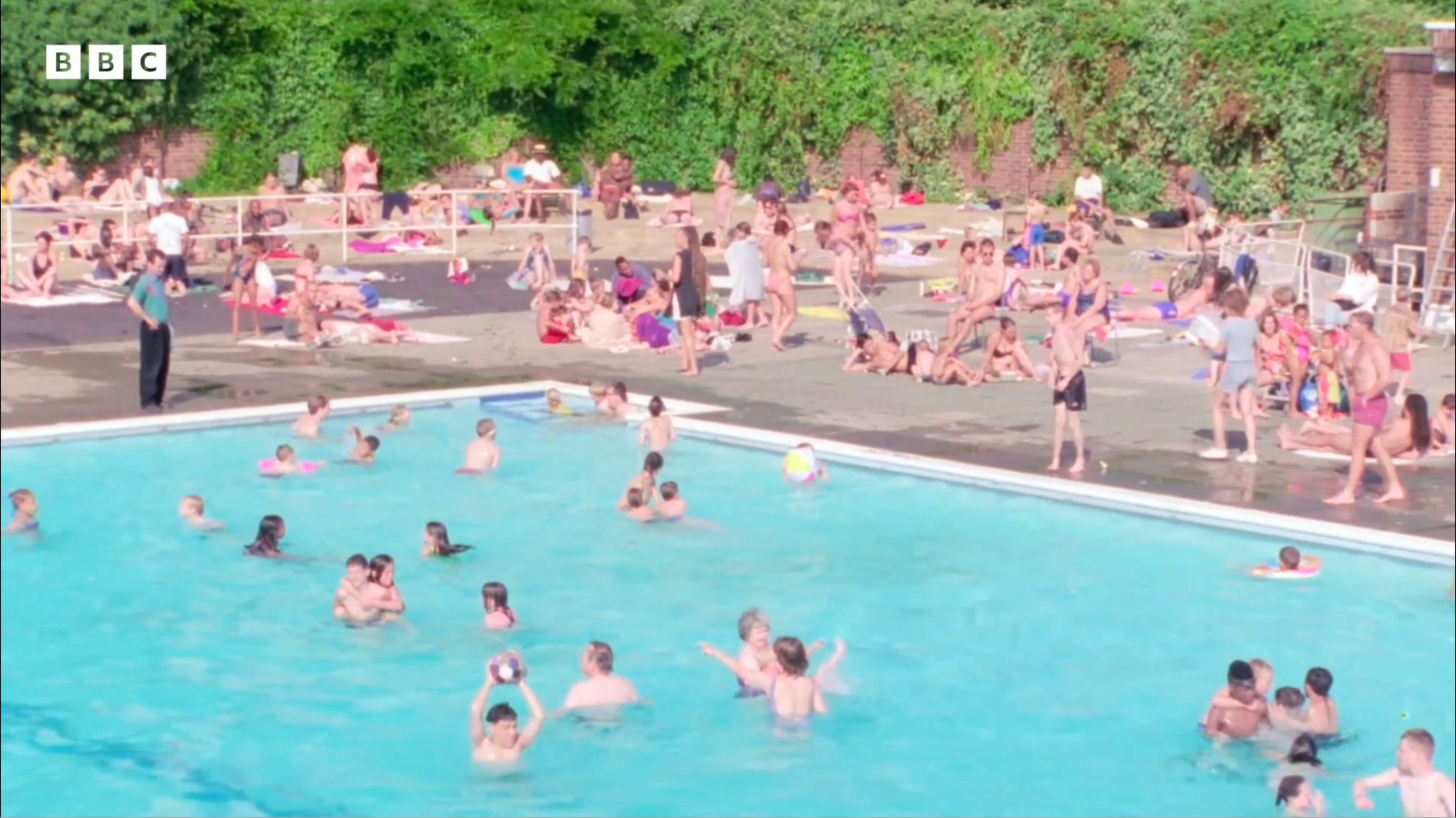
Lambert wanted something with a beginning, a middle and an end and feared it could otherwise be “like watching paint dry”.
To which Blakstad joked, “exactly, you get it now!”
After an exhaustive trawl of lidos across the country, Brockwell Park presented itself as the most sensible, production-wise, and most likely to provide the diversity she wanted in its swimmers.
With the progress of documentarians like Nick Broomfield, Molly Dineen and Kevin Macdonald, the photography of Martin Parr, and the affectionate interview tracks in Nick Park’s Creature Comforts, it was undoubtedly a golden era of growth and exploration for British creatives and ‘Britishness’ in modes of nonfiction.
But the same could not be said for the watery world of the humble lido.
The British lido & Brockwell Park
Brockwell Lido opened in 1937 to replace the public bathing ponds in the park.
The 1920s and 1930s were the boom years in Britain, with hundreds of open air pools and lidos built. Before then, the only baths large enough for swimming were the thermae constructed during the Roman occupation7. Until the 1900s, swimming for fun was rare and ‘baths’ were primarily places to wash.
“That mass washing of the 1800s and 1900s is worth noting because it laid a foundation for pool time being about leisure as well as lengths, about frolicking in the water too … the camaraderie of bath day lives on at modern lidos where time by the side of the pool is as much a part of the experience as time in the water. Munching snacks, reading novels, painting nails and scrolling through dating apps are big poolside favourites today.”
Christopher Beanland, Lido: A dip into outdoor swimming pools: the history, design and people behind them (2020)
Until this era, outdoor bathing opportunities had been restricted to men and boys. But in 1929, George Lansbury extended the popular swimming facilities at the Serpentine Lake to women too. Much was changing.
Herbert Morrison, the London County Council Chairman 1934-40, vowed to turn London into “a city of lidos”. And by 1951 there were at least 60 open air pools operating in the city: one per 120,0008.
But later decades were rough, and the 1980s the roughest. Outdoor pools were closing all around the world “mainly due to them reaching old age and needing expensive repairs, coupled with a huge drop in usage which tallied with new indoor leisure centres opening and a drastic drop in package holiday prices to sunnier climes”9.
In London, the Purely Way Lido, Croydon closed in 1979. London Fields Lido in 1988. Victoria Park Lido, the largest modern pool in London at 200 x 90 feet, closed in 1989 and was demolished in 1990 (now, a car park). And Finchley Lido followed in 1993.
Brockwell Lido was mothballed as part of cost-saving measures forced upon Lambeth Borough Council in 1990 but miraculously survived, thanks to the efforts of a Brockwell Lido Users (BLU) group.
At the time that Lido was filmed, the pool had been back in action for a year under the management of two former Council employers, Patrick Castledine and Casey McGlue.
Sir Josiah Stamp, the Governor of the Bank of England, declared at the 1936 opening of Morecombe’s new open air baths: “Bathing reduces rich and poor, high and low, to a common standard of enjoyment and health. When we get down to swimming, we get down to democracy.”10 And in the modern era, Brockwell could perhaps boast the most broad and democratic mix of all Britain’s lidos.
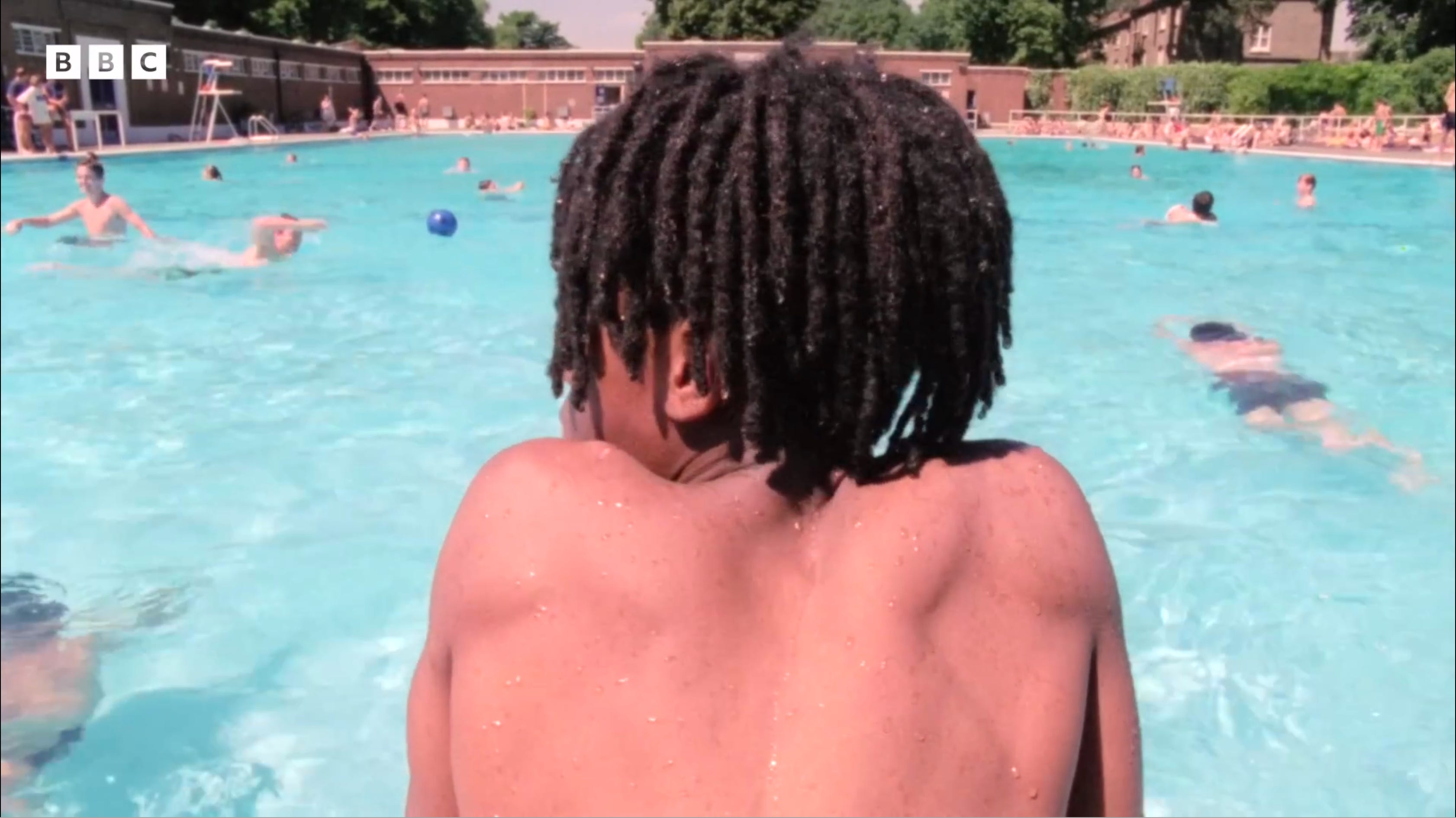
One of Lucy Blakstad’s first major tasks, as director, was to tap into this diverse cast.
“Once I’d got the OK to go ahead and do it, I sat down and I wrote down this shopping list - like a drama - if I could have my ideal six people to be in this film, who would they be? It’s never identical to what you go out and find, but it’s a very, very clear idea of what I’m looking for.”11
On that list, at one end of the spectrum, was “someone from Dulwich, privileged”. But she could never have guessed quite the level of privilege she’d discover.
Meeting the characters of the lido
The swimmers we meet in Lido are undeniably authentic, and the encounters feel spontaneous, but identifying them according to Blakstad’s shopping list of ‘ideal six people’ was a process that took two months of daily research at the pool - armed with notebooks and handycams - from 8am to 6pm.
As a rule of thumb, she might expect to find 1 in 15 of the people she shortlisted for interview genuinely interesting.
The first to make the cut is an unreconstructed pool attendant who tells us he feels “fucking rough” after a rugby club dinner the night before, followed by a strip club.
He’s somewhat of a throwback to pre-Thatcherite times, before the Health and Safety at Work Act 1974 and guidelines issued by the Health and Safety Executive made lifeguarding more stringent. Back then, “virtually any fit youth could turn up for a summer season and spend it sunbathing or chatting up the girls”12, including a young Sean Connery, who had a spell as a guard at the Portobello Baths in Edinburgh.
The next clutch we meet are a committed pensioner who frets about earplugs and devotes his mental energy during lengths to mulling over cryptic crossword clues, and a lesbian couple who tease each other about taking the first cold dip of the day.
With no great fanfare, we then see the “privileged” character that Blakstad sought. Robin Butler, soon to be Baron Butler of Brockwell, the Head of the Civil Service and later famous for the ‘Butler Inquiry’ into Britain’s intelligence on WMDs in the 2003 invasion of Iraq, is out for a brisk pre-work recreational. With him, Andrew Turnbull, Baron Turnbull, private secretary to the last two PMs: Thatcher and John Major.
It says everything about Blakstad’s approach that this sequence of characters is presented so flatly: there’s no distinction between a hungover lifeguard, a slightly dotty pensioner, a vivacious lesbian couple and a lord of the realm. When her more ‘esteemed’ interviewees slip into ‘Newsnight mode’ with their answers, she disarms and deconstructs - “it doesn’t take too much effort to just pretend I don’t get it, or I don’t understand” - to liberate more natural, conversational responses.
“I’m good at getting people to chat, and I’m cheeky. If they go into boring politician mode, or boring architect mode, answering all the questions that they’re asked all the time I know how to throw in a curveball. Then they talk like normal human beings.”13
Several of Blakstad’s characters are Black or mixed race, or, like the Ulsterman she speaks to, people who’ve experienced social segregation and conflict. It’s perhaps hard to fathom but just 30 years earlier in St Augustine, Florida, the manager of the Monson Motor Lodge poured hydrochloric acid into the water when white and Black students staged an aquatic ‘wade in’ together14.
The Brockwell Park of Lido by contrast, is not presented as a perfect rainbow coalition, but its commingling feels frictionless under the sun’s generous rays, even with the pool’s tribal groupings, and shorn of the sharp-elbowed lane swimmers that my London swimmer friends tell me sometimes spoil their sessions today.


Between the interviews that take us inside the lives and minds of the selected characters are neat interstitial edits of sharp photographic composition. “One of the reviews on Lido said ‘each shot is like a contemporary postcard’. It’s not like I got that from Martin Parr, I didn’t. It’s my graphics background and taking photographs all the time. But yes, obviously an influence”15.
It’s a dense package that, like the pool itself, feels teeming with life. One of Lido’s great achievements is that it was shot over 10-11 days, on 16mm, with around 10 rolls of film a day, and required great discipline in the prep and execution. But the end product feels like it could be one hot day’s joyful, spontaneous happenstance.
“The biggest compliment for me with the Lido film is that people said to me at the time ‘oh my god, you were so lucky that day you got to the lido, and all those fabulous people talked to you’. And that’s exactly the feeling I wanted.”16
“That split-second decision: which sector do I sit in?”
Spending an hour of overtime each day with her sound man meant Blakstad could go deeper on interviews, in a less self-conscious, audio-only environment.
But she was also keen to explore more intuitive, observational responses to the lido environment, “David Attenborough style”.
A different type of documentary might have told the story of Brockwell Lido as an architectural space. Its distinct blend of Art Deco and proto-Modernism was recognised by Grade II listed status in 2003 and boosted by a £500,000 Heritage Lottery Fund grant for restoration the following year17.
But unlike the ‘attractiveness’ of many modern swimming constructions, infinity pools imagined for endless Instagram gratification (“the Patrick Bateman of swimming pools”18), Brockwell Lido’s strong horizontal emphasis is characterised by long thin lines and a robust understatement19 that leads swimmers into functional decisions: where should I sit? (Or at least put your towel down, if diving straight in.)
“People come and they’ll do that thing and then they look around. It’s a bit like walking into a theatre where they haven’t allocated your seat numbers or something. Then they point and then their partner goes ‘what about over there?’ They have to make that split-second decision: which sector do I sit in? And people gravitate to people sort of like them.”20
Entering the lido is an emotional, ‘psychogeographic’ experience: “you have an opinion about a space the moment you step into it. This has as much to do with the space as our hardwired instincts to determine if it feels safe”21.
That sensation might change, metre by metre, as you determine the exact spot that aligns with where you feel you belong.
What Blakstad observed Attenborough-like with her long lens, her swimmers confirmed in conversation. Two friends celebrating a ‘big’ (but youngish) birthday describe the lay of the land and how “we come into every category”: the ‘happening corner’, club-goers, single mums, the gay crowd, childless couples.
Some of the positioning is obviously functional - families and single parents wanting quicker access to the cafe and amenities - others more tribal.
But as things have ‘got hotter’, unwritten rules have melted away. Another young family describes the surprising spread of “the boobs”. Just a few days before, they were confined the pool side with “the gay boys and the dope smokers” but now seen bobbling about freely amongst the family section.
Considered this way, the lido is also something of a Foucauldian ‘heterotopia’, a different or other ‘world within a world’22.
Although a public space, it’s confined by a fixed entry point. Once you’re inside, there are rules to govern clothing and conduct. And, in another Foucaudian touchstone, the pool is a place of surveillance: although most of that ‘looking’ takes place between the swimmers, as they explore the politics of exposed bodies.
The human body: self-image and detachment
In the first open season of Blackpool’s lido, in 1923, only 94,403 of the 500,000 people who passed the turnstiles were bathers. In 1937, at Weston-super-Mare, 9d in every shilling came from spectators rather than swimmers: around 75% of the total revenue.23
At a time long pre-internet, when undressed images of the human form were scarce, the lido offered a particular, unique attraction.
Even now, in the era of AI, airbrushing, GLP-1s and proliferating porn, it represents an antidote of sorts: an escape back into body reality.
“… today the pool is the place you see the bodies of everyone and anyone in all their glorious individualism. Scars, scratches, fat, ripples, muscle, curves, hair, skin of every tone. The human body is as idiosyncratic and imperfect as every doctor dispassionately knows it to be.”
Christopher Beanland, Lido: A dip into outdoor swimming pools: the history, design and people behind them (2020)
For the characters of Blakstad’s Lido, pool-going can be a chance to flirt and ogle. But it’s also a space for comparison, self-reflection, a reevaluation of self-image vs. media representations of the human body, as two of her fuller-bodied interviewees discuss.
It’s a theme that Blakstad’s returned to in both commercial and documentary work. She shot Dove’s first ‘Real Beauty’ campaign in the UK and a 1998 BBC2 four-parter Naked. More recently, she went deeper beneath the skin’s surface, directing an episode of Netflix’s The Surgeon’s Cut (2020) that explores the skill and mentality of Mexican-American neurosurgeon Dr. Alfredo Quiñones-Hinojosa.
If it’s true you “go to a lido to bathe and to be seen to bathe”24, there’s still a curious shift between the dry land stuff, spectating with neat coifs, tight trims and keen, unchlorinated eyes, and what happens to the body and mind once it enters the water.
Lido is brilliant at exploring this liminality through Andy Cowton’s soundscaping and the combined lens skills of cinematographer Mike Eley and underwater specialist Mike Valentine.
With sound, Blakstad “knew what I was looking for but I couldn’t really describe it. But I knew it would be a bit experimental”.
Cowton was an outside-of-the-box choice, known most for his work with contemporary choreographers like Russell Malliphant at Sadler’s Wells.
The layered sonic textures of Lido mix wild field recordings, contemporary tracks like Edwyn Collins ‘A Girl Like You’ and Rockers Hi-FI ‘Push Push’ as distorted by headphones and portable stereos, original, pulsing composition and plaintive jazz all occasionally submerged then brought back up to air in a rich and subjective evocation of the pool/ poolside state-shifting. The treatment allows for longer underwater takes that bring us into dreamlike suspension.
“There’s definitely something magical about being in water”, is the VO cue for the longest montage on the subject.
Somehow doubts about the body’s dry imperfections are left on the land. Weight disappears. A pregnant swimmer tells us that when she’s swimming, she “imagines that I’m suspended the same way the baby’s suspended inside me”.
On her own experience of pregnant swimming, and the reasons for swimming’s popularity during pregnancy, Blakstad said:
“The thing is, when you’re pregnant it’s such a weird feeling. In water, it just takes that weight, that massive weight that’s uncomfortable. And it just buoys you up. It’s blissful. It feels normal again.”25
Lido may never have wanted to have a beginning, middle and end. But there’s something thematically apt in that.
To view the public swimming pool experience like The Swimmer’s Neddy Merrill, as a tract in a journey, underestimates its powers. Its capacity to take you outside of the normal, larger society, a sense of regular ‘time’, the weighted expectations of the body (and its skin). To give transformation, not just transport.
“When you enter the water, something like metamorphosis happens. Leaving behind the land, you go through the looking-glass surface and enter a new world.”26
The last time I saw this film was at a Rebel Reel Cine Club outdoor screening by a body of water (and outdoor swimming spot): the Woodberry Wetlands. I wish these kinds of situational film happenings came around more often and would have given my right arm (well, not literally ) to attend this Jaws screening.
John Cheever, ‘The Swimmer’ (11 July 1964), New Yorker
Interview with Lucy Blakstad (1 June 2026)
Interview with Lucy Blakstad (1 June 2026)
Interview with Lucy Blakstad (1 June 2026)
Interview with Lucy Blakstad (1 June 2026)
Interview with Lucy Blakstad (1 June 2026)
Interview with Lucy Blakstad (1 June 2026)
Jo Edwards, ‘Building of the month September 2006 - Brockwell Lido, Herne Hill, London’, The Twentieth Century Society
Interview with Lucy Blakstad (1 June 2026)
Wilfried Hou Je Bek, quoted in Karen O’Rourke, ‘Psychogeography: A Purposeful Drift Through the City’, The MIT Press Reader
Michel Foucault, ‘Of Other Spaces, Heterotopias’ (1967)
Jo Edwards, ‘Building of the month September 2006 - Brockwell Lido, Herne Hill, London’, The Twentieth Century Society
Roger Deakin, ‘UK: Summertime blues’ (June 2000), Telegraph
Interview with Lucy Blakstad (1 June 2026)
Ahhhh this was great as this is ‘my’ pool. It has hardly changed since then. It’s insanely uncomfortable lying on the concrete, the ‘sections’ are still there and there’s the biggest cross section of life that turns up.
My friend and I often say when we’re floating in the water, looking up at the blue sky with the green trees poking into our view that it can feel like we’re abroad on holiday.
Reminded me of ‘The Ponds’ which is a very similar documentary looking at the visitors of Hampstead Ponds.
obligatory Seinfeld 'John CHEEVER' ?